Healed on a hike
by Sally H. Turner, Wilmette IL
From the Christian Science Sentinel, September 1, 2025
I love hiking in the mountains. The quiet wilderness reflects the beauty and magnificence of God, good. Rushing streams, bountiful flowers, powerful peaks, and innocent creatures all speak of God’s dominion and creativity. The mountain stream imagery in the first verse of Hymn 440 in the Christian Science Hymnal: Hymns 430–603 describes the naturalness of reaching out to God in the wilderness:
As sings the mountain stream,
Past rock and verdure wild,
So let me sing my way to You,
Your pure and happy child.
(Violet Ker Seymer, alt., © CSBD)
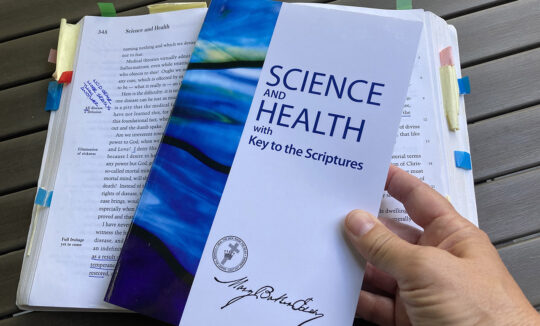
In Science and Health with Key to the Scriptures, Mary Baker Eddy, the Discoverer and Founder of Christian Science, defines wilderness as “loneliness; doubt; darkness. Spontaneity of thought and idea; the vestibule in which a material sense of things disappears, and spiritual sense unfolds the great facts of existence” (p. 597). The first part of this definition describes a dark mental place where we feel alone and uncertain. The second part gives a spiritual sense of wilderness as a place of light, in which thought sees the reality of God’s allness so clearly that the material world is understood to be unreal, and the wholly spiritual nature of existence becomes more real to us.
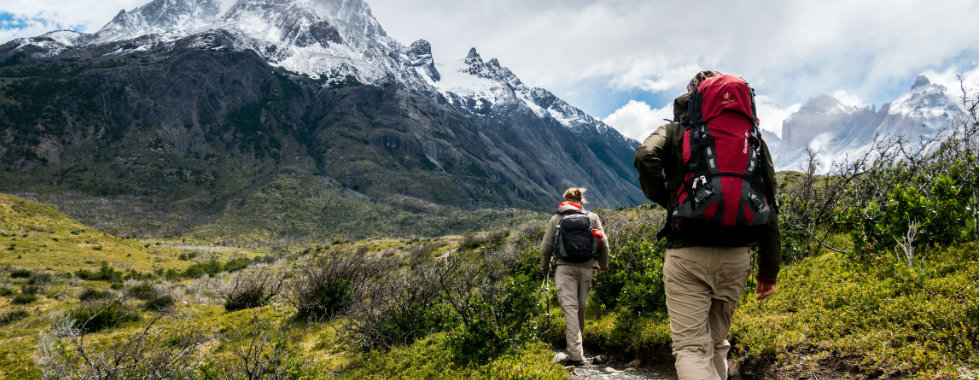
On a mountain hike last summer, I experienced this transformation of thought out of darkness into light. While on the trail, I began to feel faint and thought I might pass out. My hiking companion, a Christian Science practitioner, agreed to sit with me. As we both prayed silently, this thought came to me quite strongly: “Thy kingdom come. Thy kingdom is come; Thou art ever-present.” These words are from the Lord’s Prayer given to us by Christ Jesus and the spiritual interpretation of that prayer given in Science and Health (p. 16).
Soon, my friend said out loud, “God’s kingdom is without and within.” We were getting the same inspiration: that God was present and in control, that we were in His kingdom, and that we were witnessing His glory not only in the beauty surrounding us but also in a restoration to physical normalcy.
That was comforting and encouraging. These heavenly messages were evidence that God was speaking in a way that we could both understand and apply to this situation. I no longer felt faint. We got up and continued our hike for many happy hours, and I had no further problems.
On the trail that day, I had started out in the first part of the wilderness definition. Fear and doubt flooded my thinking with thoughts of, Will I faint? Can I finish the hike? Will I disappoint my friend if we quit? But God’s messages—spontaneous angel thoughts—ushered me into the vestibule of spiritual sense, where I felt God’s love. I experienced the truth of this statement from Science and Health: “If divine Love is becoming nearer, dearer, and more real to us, matter is then submitting to Spirit” (p. 239).
We don’t need to be lonesome, gloomy, or doubting in a wilderness experience. Neither should going through such an experience be feared. Instead, we can embrace it as an opportunity to move quickly into that vestibule of spontaneity. There we feel God’s thoughts lifting us out of the belief in the reality or substantiality of matter and planting us firmly on the path of recognizing and realizing the reality of Spirit, God. By traveling through this vestibule of thought, we are impelled toward God and His Christ. And that’s a hike worth taking!